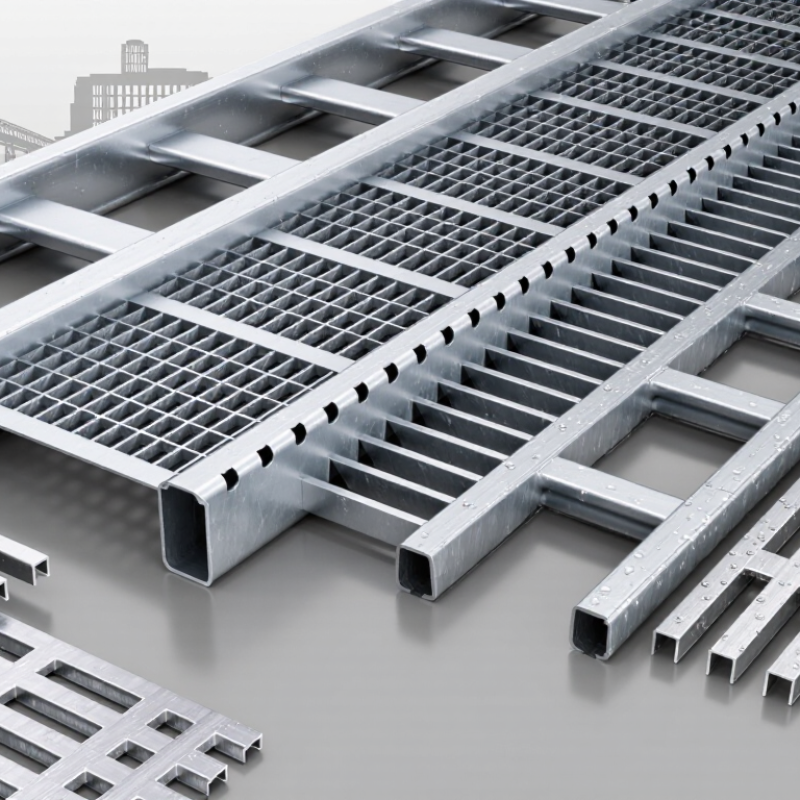
| Welded Steel Bar Grating |
Carbon steel
Low-alloy steel
|
Bearing bars are resistance-welded to cross bars, producing a rigid load-bearing panel.
|
Plain steel
Painted
Hot-dip galvanized
|
High load-carrying capability; rigid construction; widely available; suitable for industrial platforms and walkways.
|
Unprotected carbon steel can corrode. Bearing-bar depth, thickness, span, and support conditions must be checked for each project.
|
Factory platforms, plant walkways, stair treads, drainage covers, equipment platforms, and maintenance areas.
|
ANSI/NAAMM MBG 531; ASTM A36 or equivalent structural steel specifications; ISO 1461 or ASTM A123 for hot-dip galvanizing.
|
| Press-Locked Steel Grating |
Carbon steel
Stainless steel
Aluminum
|
Cross bars are forced into pre-punched or preformed slots in the bearing bars and mechanically locked.
|
Mill finish
Painted
Galvanized
|
Clean visual appearance; closely controlled openings; useful where a flush, uniform top surface is desired.
|
Mechanical interlock strength and panel deflection must be verified for heavy or impact loading. Corrosion protection depends on the material and finish.
|
Architectural floors, ventilation screens, light industrial walkways, mezzanines, and interior platforms.
|
ANSI/NAAMM MBG 531; project-specific structural and accessibility requirements.
|
| Riveted Steel Grating |
Carbon steel
Stainless steel
|
Cross bars are connected to bearing bars using riveted joints, generally creating a strong and relatively flexible panel.
|
Painted
Hot-dip galvanized
Stainless finish
|
Good resistance to vibration and repeated service loads; suitable for demanding industrial environments.
|
Usually heavier and more costly than standard welded grating. Rivet condition and corrosion protection require inspection.
|
Heavy-duty walkways, vibrating equipment areas, power facilities, bridges, and industrial maintenance platforms.
|
ANSI/NAAMM MBG 531 and applicable structural design codes.
|
| Swage-Locked Aluminum Grating |
Aluminum alloys such as 6061-T6 or 6063, subject to the supplier’s verified temper and design.
|
Aluminum cross bars are mechanically swaged into bearing bars to form a lightweight panel.
|
Mill finish
Anodized
Powder coated
|
Low weight; good atmospheric corrosion resistance; easier handling and installation than steel grating.
|
Lower stiffness and strength than comparable steel sections. Avoid direct contact with incompatible metals where galvanic corrosion is possible.
|
Marine facilities, wastewater plants, rooftops, lightweight platforms, transportation areas, and chemical-processing accessways.
|
ANSI/NAAMM MBG 531; applicable aluminum alloy and structural design specifications.
|
| Stainless Steel Bar Grating |
Type 304 stainless steel for general corrosion resistance
Type 316 stainless steel for chloride-rich or marine exposure
|
Commonly welded or press-locked, depending on the required load and appearance.
|
Mill finish
Pickled and passivated
Polished
|
Strong corrosion resistance; hygienic surface; long service life in many chemical, food, and marine environments.
|
Higher initial material cost. The selected grade must match chloride concentration, chemicals, temperature, and cleaning conditions.
|
Food-processing facilities, pharmaceutical areas, chemical plants, coastal platforms, water treatment, and hygienic drainage zones.
|
ANSI/NAAMM MBG 531; ASTM A240 or equivalent stainless-steel material specifications; EN 10088 where applicable.
|
| Heavy-Duty Press-Locked Grating |
Carbon steel
Stainless steel
|
Uses deeper and/or thicker bearing bars with mechanically locked cross bars for higher design loads.
|
Plain
Painted
Galvanized
|
Designed for concentrated loads, forklift traffic, maintenance vehicles, and demanding industrial service.
|
Panel weight, support details, wheel loads, impact loads, and deflection limits must be engineered rather than selected only by mesh size.
|
Loading bays, mining facilities, heavy manufacturing plants, transport terminals, and vehicle-access platforms.
|
ANSI/NAAMM MBG 531; applicable national structural, live-load, and accessibility regulations.
|
| Serrated Safety Grating |
Carbon steel
Aluminum
Stainless steel
|
Bearing-bar top surfaces are formed or machined with serrations to improve traction.
|
Galvanized
Mill finish
Stainless finish
|
Improved slip resistance in wet, oily, muddy, or icy conditions compared with plain-top grating.
|
Serrations can be less comfortable for barefoot or low-clearance contact. Surface performance depends on geometry, contamination, footwear, and maintenance.
|
Outdoor stairs, oil and gas facilities, wastewater plants, food-processing service areas, ramps, and wet platforms.
|
ANSI/NAAMM MBG 531; EN ISO 14122-2 and applicable local safety requirements.
|
| Expanded Metal Grating |
Carbon steel
Aluminum
Stainless steel
|
A single metal sheet is slit and stretched to create a continuous mesh without separate welded cross bars.
|
Plain
Painted
Galvanized
Anodized
|
Continuous construction; good airflow and visibility; reduced waste during production; available in many mesh patterns.
|
Load capacity depends strongly on sheet thickness, strand dimensions, mesh orientation, and support spacing. It is not automatically interchangeable with bar grating.
|
Guards, screens, light-duty walkways, ventilation panels, platforms, ramps, and machine enclosures.
|
ASTM F1267 for expanded metal products; project-specific structural and safety requirements.
|
| Perforated Metal Floor Grating |
Carbon steel
Aluminum
Stainless steel
|
Holes are punched or otherwise formed in sheet metal, with the pattern selected for drainage, airflow, or appearance.
|
Painted
Galvanized
Anodized
Stainless finish
|
Controlled open area; smooth and uniform appearance; useful where small openings or particle control are important.
|
Open area, hole geometry, sheet thickness, and unsupported span determine drainage and load performance. Some patterns may clog more easily than bar grating.
|
Walkways, machine covers, ventilation panels, equipment decks, raised floors, and architectural applications.
|
ASTM B117 may be used for corrosion-testing programs; structural design and accessibility requirements must be specified for the project.
|
 Jiulong